Free tool
TDEE and macro calculator
Work out the calories you burn in a day, then a daily target and macro split for your goal.
Your daily target
1,750calories a day
That's your maintenance minus 250 calories a day.
BMR
1,452kcal
Burned at complete rest
Maintenance (TDEE)
1,996kcal
Including daily activity
Protein · 30%
131g
Carbs · 40%
175g
Fat · 30%
58g
Estimates, not medical advice. This uses a population-average equation and knows nothing about your body composition, medications, or medical conditions. If you are pregnant, managing a health condition, or have a history of disordered eating, talk to a doctor or dietitian before setting a calorie target.
How the numbers are calculated
Your BMR comes from the Mifflin-St Jeor equation, which has been the clinical default since it outperformed the older Harris-Benedict formula in validation studies:
- Men: (10 × kg) + (6.25 × cm) − (5 × age) + 5
- Women: (10 × kg) + (6.25 × cm) − (5 × age) − 161
That result is multiplied by an activity factor — 1.2 for sedentary up to 1.9 for athletes training twice a day — to give your TDEE. Your goal then adds or subtracts a fixed number of calories from it.
Picking an activity level honestly
This is where most people get the wrong answer, and they almost always err in the same direction. A desk job plus three gym sessions a week is light to moderate, not very active. “Very active” means hard training six or seven days a week, or a job that keeps you on your feet all day. If you’re between two options, pick the lower one — an overestimated TDEE turns an intended deficit into maintenance, and then it looks like your metabolism is broken when nothing is happening.
Why the macro split matters less than the calories
Total calories drive weight change. The split determines how you feel and what you keep while it happens. Protein is the one worth being deliberate about: it preserves muscle in a deficit and is markedly more filling per calorie. Beyond hitting a sensible protein target, the carb-to-fat ratio is mostly a question of what you enjoy eating and can sustain.
Adjust from reality, not from the formula
Use this number for two to three weeks and weigh yourself under consistent conditions — same time of day, same clothing. If your weight hasn’t moved in the direction you want, adjust by about 10% and hold again. Daily fluctuations of a kilo or two are water and gut contents, not fat; the trend across weeks is the signal.
If you’re pairing this with a fasting schedule, the fasting calculator will tell you when the window opens, and the BMI calculatorgives another rough reference point for where you’re starting.
Common questions
What is TDEE?+
Total Daily Energy Expenditure — the total calories your body burns in a day. It combines your BMR (what you burn at complete rest), the energy used digesting food, and everything you do while awake, from deliberate exercise to fidgeting and walking to the kitchen.
What's the difference between BMR and TDEE?+
BMR is what you would burn lying still all day. TDEE is BMR multiplied by an activity factor to account for real life. For most people TDEE is 20% to 90% higher than BMR, which is why the activity level you pick changes the result so much.
How accurate is this calculator?+
The Mifflin-St Jeor equation is the most accurate of the common formulas, but it still typically lands within about 10% of measured expenditure — roughly 200 calories a day for an average adult. It cannot see your body composition, thyroid function, or genetics. Treat the number as a starting point, then adjust based on what the scale actually does over two to three weeks.
How many calories should I cut to lose weight?+
A deficit of 250 to 500 calories a day is the usual recommendation, producing roughly half a pound to a pound of loss per week. Larger deficits are not proportionally better: they cost you muscle, energy, and adherence, and the weight tends to return. This calculator will not recommend below 1,200 calories for women or 1,500 for men.
How much protein do I need?+
For someone in a calorie deficit who wants to hold onto muscle, roughly 1.6 to 2.2 grams per kilogram of body weight per day is the range supported by most research. The high protein split above lands most people in that range. Protein also keeps you fuller than the same calories from carbs or fat, which matters a lot when you're eating less.
A target you can actually hit
Snap the meal. It does the numbers.
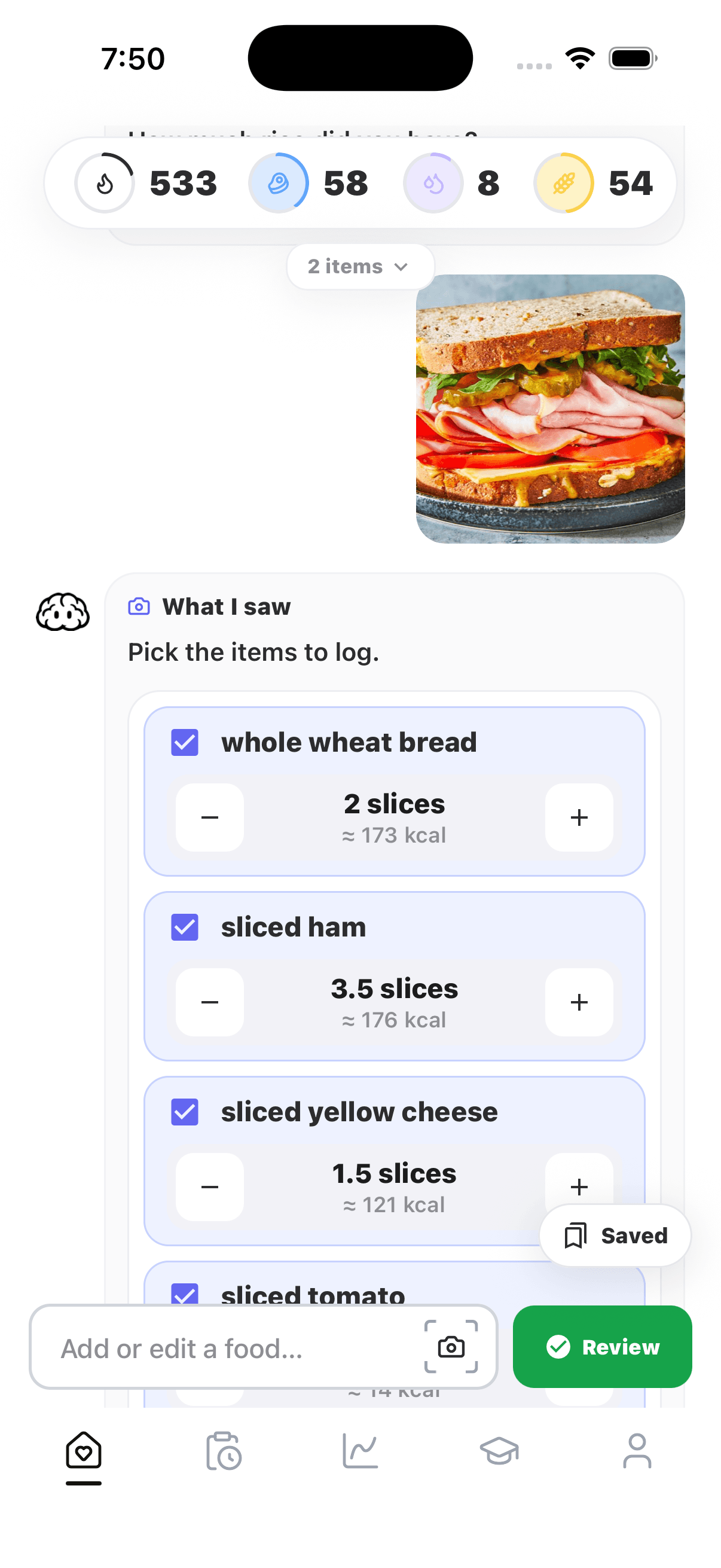
A calorie goal only works if logging is effortless. Photograph what you're eating and Fastiq fills in the calories, protein, carbs, and fat.